

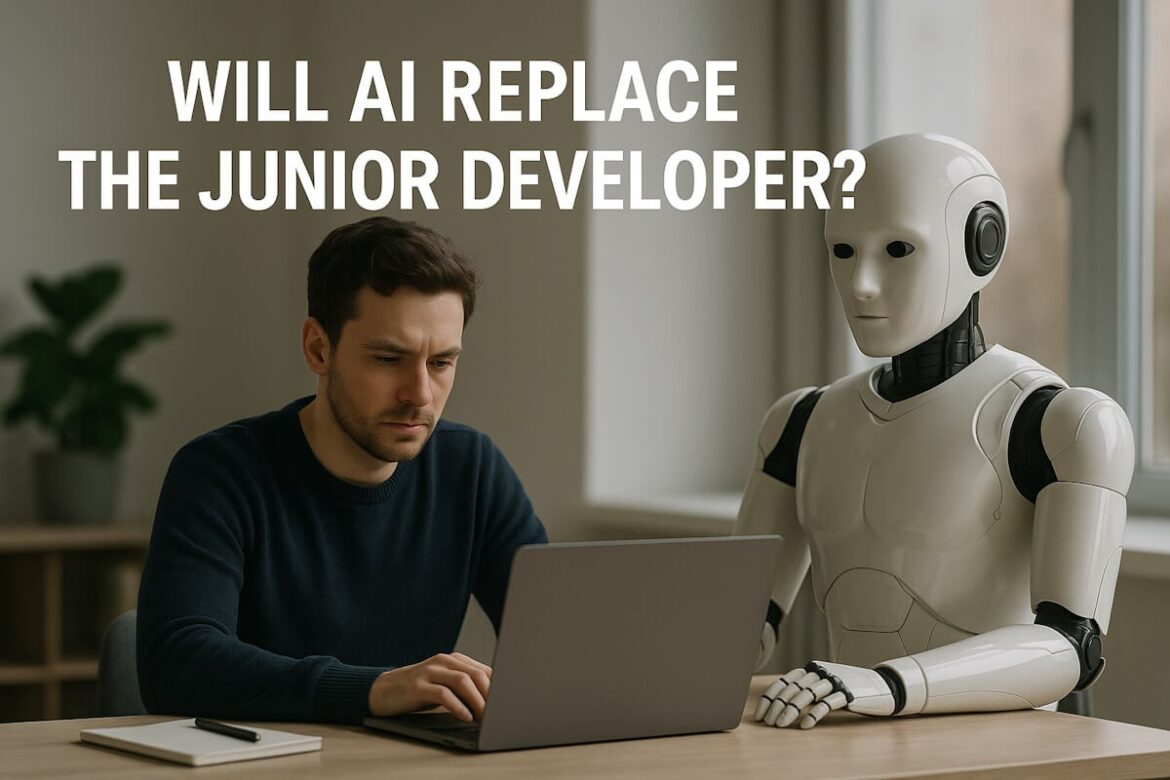
There’s been a lot of buzz about AI shaking things up in tech, especially in software development. People are asking the big one: Will AI replace junior developers? Some are panicking, others are brushing it off. But here’s the thing—both sides are missing the full picture.
To get a clear answer, you’ve got to look at how software development is changing, how AI is actually being used by teams, and what the future looks like for entry-level devs. Spoiler: it’s not as black and white as “yes” or “no.”
Let’s break it down with facts, not hype.
What Junior Developers Actually Do
Before we talk AI, let’s rewind and look at what junior devs have typically been responsible for:
- Squashing low-priority bugs
- Writing small features or enhancements
- Creating and tweaking UI components
- Reviewing logs and fixing minor errors
- Writing tests
- Shadowing senior devs and learning best practices
- Jumping into support or maintenance work
In short, a lot of learning-by-doing. Junior devs aren’t expected to architect massive systems. They’re expected to grow while contributing in manageable ways. That’s how most teams build depth for the future.
So what happens when AI enters the mix?
What AI Can Actually Do Right Now
Let’s not overstate it. AI tools have come a long way, but they’re not magic. They’re fast, useful, and sometimes shockingly accurate. But they still need babysitting.
Here’s what they’re being used for on real dev teams:
- Code suggestions: IDE plugins that finish code or suggest snippets
- Debugging help: Explaining error messages and suggesting fixes
- Test generation: Writing basic unit tests based on code context
- Documentation: Auto-generating docstrings or comments
- Code reviews: Flagging risky code or breaking changes
Tools like Copilot, Tabnine, and ChatGPT are changing how developers write and review code. But at the end of the day, someone still needs to understand what the code is doing and why.
That someone? Still a human.
Where AI Helps—and Where It Doesn’t
AI can help with repetitive stuff. It’s great at following patterns. That’s why tasks like writing boilerplate or suggesting function names get handled quickly by AI tools.
But when things get weird? Or when requirements change? That’s when you need a real person.
Here’s what AI still struggles with:
- Context: Knowing how this one function fits into a giant system
- Project-specific logic: Every app has weird edge cases. AI doesn’t know yours.
- Unclear requirements: If the client changes their mind mid-sprint, AI can’t negotiate.
- Collaboration: AI doesn’t join standups, brainstorm, or explain trade-offs to product teams.
So yeah, AI is strong on tasks. But weak on teamwork, communication, and thinking in grey areas. That’s still where junior devs shine.
What’s Changing in Hiring: The AI Interview Platform Shift
Hiring is adapting too. A lot of companies are using automated tools to screen applicants faster. This includes AI-powered platforms that run coding assessments, evaluate logic, and even analyze how candidates talk through problems.
These AI interview platform setups can look like:
- Timed coding challenges
- Asynchronous video interviews
- Automated grading of logic, style, and correctness
- Behavioral analysis based on recorded answers
It’s not perfect, but it does speed things up. Especially for companies getting hundreds of applications per role. That said, it’s not a total replacement for human interviews.
Most recruiters and hiring managers still want to see how you think, how you work with a team, and how you respond to feedback. So while AI might be your first hurdle, people still make the final decision.
If you’re preparing for tech interviews, get used to these tools. Practice writing code in a browser. Record yourself explaining problems. Understand what the AI might be flagging—things like time complexity or missing edge cases.
Companies Aren’t Looking to Cut Entry-Level Roles—Yet
Let’s clear something up. Most companies aren’t actively looking to replace junior devs with AI. What they are doing is shifting expectations.
You’re expected to be faster. Smarter with your tools. More proactive about learning.
Teams are using AI Software Development Services to build tools that speed up the dev process. But those tools need humans too—especially for setup, maintenance, and feedback loops.
In fact, AI adoption is creating more technical work in some areas:
- Integrating AI with internal systems
- Building prompts and workflows that work reliably
- Reviewing AI outputs to make sure they’re correct
- Updating AI models or fine-tuning outputs
That’s where entry-level devs come in. They’re often assigned these supporting tasks. It’s grunt work, sure—but it’s how they get up to speed.
So don’t assume fewer jobs. Just different ones.
What Junior Developer Roles Might Look Like in 2026
Expect the job to feel more like this:
- Prompting AI to generate code, then reviewing it
- Debugging AI suggestions that don’t quite work
- Collaborating with design, product, and QA to handle parts AI can’t
- Writing glue code between services, APIs, and systems
- Reviewing AI-generated pull requests before merging
You’ll still be learning, but you’ll also be spending more time managing tools. Not building every feature from scratch. The skillset will shift from just “write code” to “understand systems and guide tools.”
You won’t be expected to out-code the AI. You’ll be expected to work alongside it—and catch its mistakes.
AI Isn’t the Threat—Complacency Is
The junior devs who’ll struggle the most aren’t the ones who don’t know deep tech. It’s the ones who rely on AI to do all the work without understanding what’s going on.
If you’re not building foundational knowledge, AI tools become a crutch. And once something breaks, you won’t know how to fix it.
Here’s how to stay competitive:
- Learn the basics: Don’t skip CS fundamentals, even if you use AI daily.
- Understand the tools: Know how to use AI tools properly. Prompt well, verify results.
- Build stuff solo: Try making projects without AI, just to stay sharp.
- Follow real-world codebases: Open source projects help you see how software actually works.
- Practice on AI interview platforms: Get comfortable with auto-assessed formats.
Treat AI like a calculator, not a tutor. Use it to speed up, not to skip learning.
What Companies Are Looking For (That AI Can’t Provide)
AI can write code. But it can’t:
- Handle client meetings
- Make trade-offs between technical and business needs
- Think long-term about maintenance
- Read between the lines of vague feature requests
- Give thoughtful code reviews
- Mentor junior teammates
These things all require human judgment. And even junior devs play a part here. Your questions, your insights, your ability to admit when something’s unclear—that’s valuable. That’s not going away.
Teams building custom tools with AI Software Development Services aren’t cutting out devs. They’re just expecting more collaboration, faster iteration, and smarter decision-making. That includes the folks just starting out.
So… Will AI Replace Junior Developers?
No. But it will replace parts of the job.
Expect fewer roles focused on low-value, repetitive work. But expect more roles that require understanding, flexibility, and smart use of AI tools.
Your title might still be “Junior Developer.” But your job will involve prompt engineering, quality control of machine-generated code, and faster delivery cycles. You’ll still grow into a mid-level or senior engineer. The path isn’t disappearing—it’s just getting a few new checkpoints.
If you’re learning to code, keep going. Learn the tech. Learn the tools. Build real stuff. Stay curious.
AI’s not your competition. It’s your co-worker.