

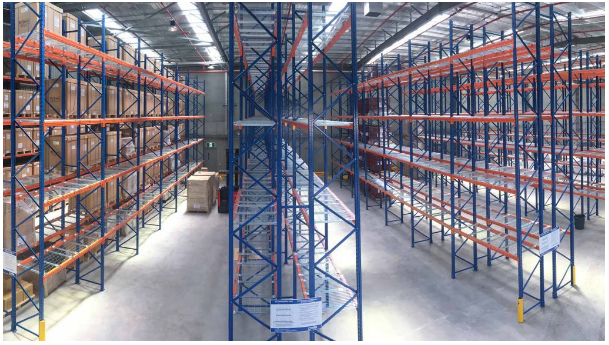
Effective inventory management is critical for firms that rely on efficient warehousing and distribution. From receiving incoming goods to fulfilling customer orders, every stage of inventory handling relies on knowing where products are stored, how much stock is available and how quickly it can be accessed. When warehouse storage is disorganised, even simple tasks can become time-consuming, increasing the possibility of picking errors, misplaced goods, and unnecessary handling.
A well-planned warehouse storage system provides the framework required to address these difficulties. Businesses may increase stock visibility, make greater use of existing space, and run more smoothly by combining appropriate storage equipment, clear inventory structure, and consistent warehouse procedures.
1. Create a Logical Warehouse Layout
The foundation of effective stock management is a warehouse plan that facilitates the movement of goods. Products should have specific storage areas based on their size, weight, demand, and handling needs. This allows team to determine where objects belong and get them without unnecessary movement.
A realistic solution is to separate the warehouse into clearly defined zones for receiving, storing, picking, packaging, and shipping. Frequently ordered products can be placed closer to picking and dispatch areas, while slower-moving inventory can be stored in less accessible locations, as long as handling and safety criteria are met.
Clear aisle markers, location labels, and well-organised storage bays all help navigation. When employees can identify storage locations quickly, stock retrieval becomes more consistent and the chances of products being misplaced are reduced.
2. Choose the Right Pallet Racking System
Storage equipment is an essential factor in determining how efficiently a warehouse functions. Choosing the right racking layout enables organisations to maximise vertical space, organise inventory, and preserve access to stored products.
When researching pallet racking Melbourne solutions, firms should consider the nature of their inventory, available floor space, stock turnover, and material handling equipment.
Why Selective Pallet Racking Works for Different Inventory Types
Selective pallet racking is a popular storage structure because it allows direct access to specific pallet locations. Unlike high-density systems that may require moving other pallets to reach a particular load, selective racking allows forklift operators to retrieve specific products independently.
This makes it especially beneficial for warehouses that handle several product lines, changing stock numbers, and rapid order changes. Businesses can create designated bays for distinct product categories, making stock identification and restocking easier.
The system can also be built with different beam levels to suit varied pallet heights, depending on the design parameters and safe load limits. This adaptability makes selective racking a viable choice for organisations that value accessibility and inventory variation.
3. Introduce Consistent Stock Identification Practices
Even a well-designed storage layout cannot deliver effective stock management without accurate product identification. Every storage site should have its own reference, which should be backed up by clear labelling and a structured inventory management system.
Barcode scanning and warehouse management systems (WMS) can assist organisations in tracking stock movements when products enter, exit, or change storage places. When these records are routinely updated, warehouse teams have a better understanding of available inventory and can spot discrepancies more easily.
Product codes, descriptions, quantities, and specific storage locations should all be part of an organised identification procedure. Businesses can also employ inventory classification techniques, such as ABC analysis, to prioritise frequently sold or operationally critical products.
Combining these procedures with clearly designated racking bays reduces misunderstanding and simplifies stock verification.
4. Make Better Use of Vertical Storage Space
Expanding warehouse capacity does not always necessitate more floor space. In many facilities, unused vertical space provides a chance to increase inventory capacity within the existing footprint.
Businesses can store items on numerous levels with properly engineered pallet racking systems, decreasing their dependency on floor-level stacking. However, storage height must be planned in accordance with building conditions, pallet dimensions, forklift capabilities, and the racking’s structural capacity.
Aisle widths should also be carefully considered. They must allow the chosen material handling equipment to function safely during picking and restocking operations. Maximising storage density should never be at the expense of accessibility or safe movement.
5. Establish Regular Stock Audits and Racking Inspections
Organised storage is an ongoing responsibility, not a one-time installation. Regular stock audits allow organisations to compare recorded inventory to actual numbers, uncover inconsistencies, and rectify issues before they impact order fulfilment.
Cycle counting is a practical method. Instead, than inspecting the entire inventory at once, warehouse team check specific products or storage sites at regular intervals. This helps to keep correct records without disrupting everyday activities needlessly.
Physical storage infrastructure also requires maintenance. Racking should be inspected for evident damage, overload, and unauthorised modifications. WorkSafe Victoria recommends regular inspections, including formal inspections performed by a competent person at least once every 12 months. Safe working load restrictions must also be fully recognised and observed.
These checks assist to protect team, stored items, and the continuation of warehouse operations.
Conclusion
Effective stock management requires more than just precise inventory data. It necessitates a warehouse environment in which products are rationally structured, storage locations are easily identifiable, and things can be accessible with minimal handling.
Businesses can improve warehouse efficiency and manageability by investing in appropriate storage layouts, using consistent stock identification methods, and conducting regular inspection routines. Whether renovating a current facility or building a new one, the correct combination of storage systems and inventory procedures can help with greater space utilisation, stock visibility, and more reliable daily operations.