

There’s a building style that’s been quietly taking over the world. You’ve seen it in gallery openings, in architectural magazines, in the sleek new office buildings popping up in our cities. It’s bold. It’s unapologetic. It celebrates materials for what they are rather than hiding them behind pretence.
It’s called the New Brutalism.
And at its heart are two materials that have been around for centuries but are finally getting the appreciation they deserve: steel and concrete.
The Old Brutalism: A Brief History
Let’s rewind. The original Brutalism emerged in the mid-20th century, named after the French term béton brut meaning “raw concrete.” Architects like Le Corbusier and the Smithsons championed it. The style was honest, functional, and unadorned. Concrete was left exposed. Structure was celebrated. Form followed function.
But Brutalism fell out of favour. The concrete often weathered poorly. The buildings felt cold and imposing. By the 1980s, the style was widely criticised, and many brutalist structures were demolished or reclad.
Then something interesting happened. A new generation of architects started looking back at those old brutalist buildings with fresh eyes. They saw honesty, strength, and potential. They started experimenting with the same principles—but with better materials, better techniques, and a more refined sensibility.
New Brutalism was born.
The New Brutalism: What’s Different
Today’s brutalist architecture shares the same DNA as its predecessor—honest materials, structural expression, minimal ornamentation—but it’s evolved in crucial ways.
Better materials. Modern concrete is stronger, more durable, and more versatile. Additives and treatments prevent the weathering issues that plagued old brutalist buildings. The concrete stays beautiful longer.
Precision engineering. The steel reinforcement used in contemporary architecture allows for thinner, more elegant concrete sections. Walls can be slimmer. Cantilevers can be more dramatic. The structure becomes more expressive.
Warmer textures. Today’s architects use board-formed concrete, textured finishes, and integrated timber to add warmth and humanity. It’s not cold anymore. It’s tactile.
Integrated sustainability. Modern brutalist buildings often incorporate passive solar design, natural ventilation, and green roofs. The honesty of the materials extends to the honesty of the building’s environmental performance.
Why Steel is Essential to the New Brutalism
You can’t have New Brutalism without steel. It’s the skeleton that makes everything possible.
The cantilever. Think of those dramatic balconies that seem to float in space. The thin concrete roof that appears to hover. The building that steps out over its site without visible support. All of this requires high-tensile steel reinforcement hidden within the concrete.
The slender profile. Old brutalist buildings often felt heavy and massive because the concrete had to be thick to handle the loads. Modern steel-reinforced concrete can be much thinner while carrying the same weight. The result is elegance, not bulk.
The complex geometry. Today’s brutalist buildings aren’t just boxes. They’re sculptural. Curving. Angular. Dynamic. Steel reinforcement can be bent and shaped to follow any form, allowing architects to push boundaries that were previously impossible.
The seamless integration. Steel also handles the connections—joining concrete to concrete, concrete to glass, concrete to timber. The structural steel systems used in modern design create buildings that feel cohesive and intentional, not cobbled together.
When it comes to structural steel beams, section choice matters. A 150UB handles lighter loads and shorter spans — ideal for single-storey applications and internal wall removals. Step up to a 200UB18 and you have the capacity for medium-span openings: kitchen walls, living area extensions, bedroom lintels. For full-width open-plan transformations or second-storey loads, a 250UB25 delivers the load-bearing performance required without sacrificing the slender, expressive profile that defines the brutalist aesthetic. These are the sections you’ll find specified by structural engineers on renovation and new-build projects across Victoria — and they’re the sections we supply.
Where You See It: The New Brutalist Icons
You might not have noticed the pattern, but once you do, you’ll see it everywhere.
Cultural institutions. Art galleries, museums, and performance spaces have embraced the New Brutalism. The Tate Modern in London, the National Gallery of Canada in Ottawa, the M+ Museum in Hong Kong—all celebrate raw concrete and exposed structure.
Residential architecture. High-end homes are increasingly adopting the aesthetic. Board-formed concrete walls, steel-framed glass pavilions, cantilevered upper floors. The look is sophisticated, modern, and surprisingly warm.
Public buildings. Libraries, town halls, and community centres are being designed with brutalist principles—durable, honest, and built to last.
Commercial spaces. Offices and retail spaces are using the aesthetic to signal creativity and authenticity. Raw concrete and exposed steel say “we’re real, we’re modern, we’re not hiding anything.”
What Makes It Work: The Material Dialogue
The magic of New Brutalism is the conversation between steel and concrete.
Concrete handles compression. It’s the muscle, the mass, the presence. Steel handles tension. It’s the sinew, the strength, the hidden power. Together, they create structures that are both massive and delicate, both raw and refined.
This dialogue is visible in the finished building. The concrete expresses form and texture. The steel expresses connection and tension. Neither dominates. Both are essential.
The Emotional Response
There’s something about a well-executed brutalist building that moves people. It’s honest. It doesn’t pretend. It stands there, unapologetically itself, and asks you to engage with it.
That honesty resonates. In a world of disposable architecture, of plaster facades and fake materials, buildings that celebrate their true nature feel almost revolutionary.
They’re also supremely practical. They last. They weather well. They require less maintenance than buildings with applied finishes. They get better with age rather than worse.
A Word for Homeowners
You might be thinking: This is all very interesting, but I’m not building a museum or an office tower. What does this mean for me?
Here’s the thing. The principles of New Brutalism—honest materials, structural expression, quality over decoration—are just as relevant for homes as they are for public buildings.
That exposed concrete wall in your extension. The steel beam you chose to leave visible rather than hiding in the ceiling. The honest, durable materials that will age beautifully rather than needing constant replacement.
You don’t need to build a brutalist masterpiece to embrace the philosophy. You just need to make choices that value authenticity, durability, and structural honesty.
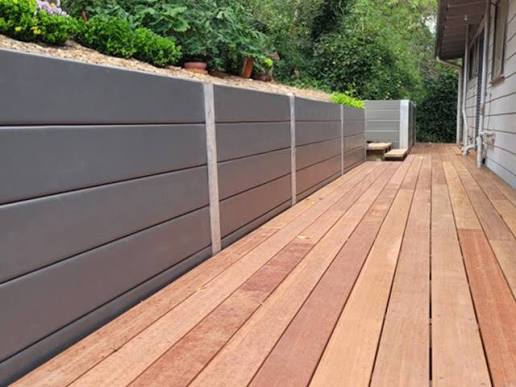
The same philosophy extends to your outdoor spaces. A retaining wall doesn’t have to be a block of concrete or a stack of sleepers hidden behind plantings. Built with proper retaining wall steel — galvanised steel posts set into the ground and paired with concrete sleepers or hardwood — it becomes part of the architectural composition. Galvanised steel posts resist corrosion for decades without maintenance. They don’t rust, crack, or warp. Steel retaining wall posts carry significant lateral loads from soil and water, especially on sloped Melbourne blocks where inadequate retaining causes costly failures. That’s the brutalist philosophy applied to your garden: structural honesty, honest materials, built to last.
The Future of Architecture
The New Brutalism isn’t a passing trend. It’s a fundamental shift in how we think about buildings. We’re moving away from the superficial and towards the substantial. Away from applied decoration and towards structural expression. Away from disposable and towards permanent.
Steel and concrete are at the heart of this shift. And they’re defining the architecture of the 21st century.
About the Author
RW Steel Victoria is a Victorian steel supplier specialising in structural and architectural steel for residential, commercial, and civil projects. From 150UB and 200UB18 beams for residential renovations to 250UB25 sections for large open-plan builds, RW Steel stocks the profiles engineers and builders need. We also supply galvanised steel posts and retaining wall steel — including galvanised H channel steel posts and sleeper retaining wall systems — for landscaping and civil earthworks across Melbourne and regional Victoria. Visit rwsteelvictoria.com.au or contact us for a quote on your next project.