
Drive through Alexandria, St Peters, Silverwater or Smithfield and look up. Long, grey corrugated roofs, one after another, over warehouses and factories that have stood there for decades.
A lot of that roofing is asbestos cement.
Most of these suburbs were built up well before asbestos was banned at the end of 2003, and plenty of the buildings are still standing. Some still run production lines. Others are on their way to becoming gyms, breweries, studios, or apartments.
Either way, the asbestos stays until someone takes it out properly.
So why are these sites so tricky?
Why older facilities are harder than they look
A house might have one fibro laundry. A factory can have asbestos in a dozen various places.
Start with the roof and walls. They are usually bonded asbestos cement, and on older Sydney factories you will often find a sawtooth roof, which is awkward to get onto at the best of times.
Then go inside. Steam lines with old lagging. Insulation packed around boilers and ovens. Gaskets in pumps and valves nobody has opened in years. Asbestos backed switchboards.
The offices and lunchroom have their own share, usually vinyl floor tiles and old ceiling panels. And where buildings were knocked down years ago, fragments sometimes turn up in the soil.
Time does not help. Decades of sun, salt air near the coast and summer storms leave old sheeting brittle and cracked. It snaps more easily once work starts, which makes it harder to remove safely.
The rules in NSW
In NSW, asbestos at work falls under the Work Health and Safety (WHS) laws, and SafeWork NSW enforces them. The NSW EPA looks after how the waste is transported and where it is disposed of.
For a site built before 31 December 2003, whoever manages or controls it generally has to identify asbestos (or assume it is present) and keep an up to date asbestos register. If asbestos is found, they will also need an asbestos management plan, plus a licensed removalist for any work that calls for one.
The licences split like this. Friable asbestos needs a Class A. Bonded asbestos over ten square metres needs at least a Class B.
Before work starts, the licensed removalist notifies SafeWork NSW. Once it is finished, there is a clearance inspection.
The challenges you will actually run into
Working at height
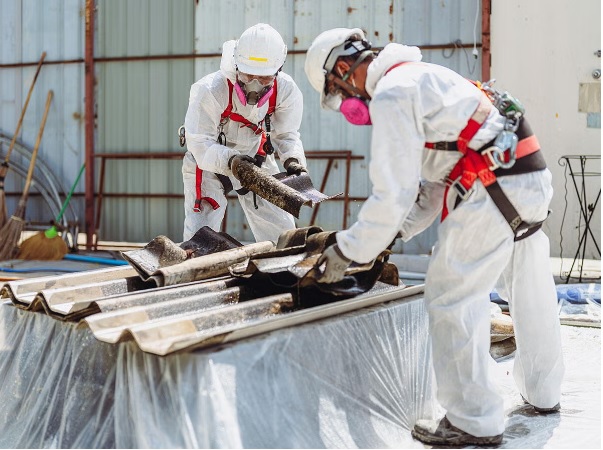
Warehouse roofs are big, high, and often fragile. You need edge protection, safe access and a plan sorted before anyone climbs up. Nobody walks on old sheets unsupported.
Keeping the business running
Few sites can close for a month. So, removal tends to be staged, moved to weekends, or squeezed in between production runs and truck deliveries.
Mixed materials
Friable lagging in the boiler room. Thousands of square metres of bonded roofing on the warehouse. Same site, two vastly different jobs, each with its own licence and controls.
Tenants and neighbours
In mixed use pockets, a factory might share a back fence with houses, a café, or another business. Exclusion zones and dust control matter here, and so does telling the neighbours what is happening before the scaffold goes up.
Waste volumes
A big roof makes a lot of waste. Every load has to be wrapped, labelled and taken to a facility licensed to accept it. For larger loads, the NSW EPA tracks movements through its WasteLocate system.
Conversions and redevelopments
This is where asbestos causes the most grief.
Plenty of older Sydney warehouses are being converted or redeveloped. Before any strip out, refit or demolition, the asbestos has to be found and dealt with. Find it halfway through and the job stops while it is assessed, removed, and cleared.
A pre demolition or pre refurbishment survey avoids most of that. The assessor checks inside walls, under floors and above ceilings, so the removal scope is settled before the builders arrive.
What good industrial asbestos removal services look like
Good industrial asbestos removal services do far more than cart material off site.
First they will go through your register and organise any testing. Then comes the asbestos removal control plan, the notification to SafeWork NSW and the controls the job actually needs. Friable work means sealed enclosures and air monitoring. Bonded roofing means wet methods and safe roof access.
They will understand how an industrial site runs, too. Isolations, permits, shutdown windows. Working through those with your team stops production stalling any longer than it has to.
When an area is finished, it is inspected and a clearance certificate is issued before anyone goes back in. The waste ends up where it should, and you keep the paperwork.
Choosing a removalist
Comparing industrial asbestos removal services? Put these questions to each one:
- Do you hold the right SafeWork NSW licence for every material on site?
- Have you worked on large warehouses and factories that were still operating?
- Are your crews trained for heights, confined spaces, and plant isolation?
- Can you stage the work around our operations?
- How do you handle air monitoring, clearance, and waste tracking?
- Will you help update our asbestos register afterwards?
The answers sort out pretty quickly who does industrial work and who mostly does houses.
Getting started
Running an older warehouse, factory, or facility? Pull out the asbestos register first. Does it cover every building, roof, and bit of plant you plan to touch?
If not, book a survey. Then talk to a licensed provider of asbestos removal Sydney NSW businesses trust, while there’s still room to fit the work into your program.
Planning a new roof, a warehouse refit, or a demolition? For asbestos removal Sydney NSW wide, bring the removalist in before the dates are locked.